


July 2026
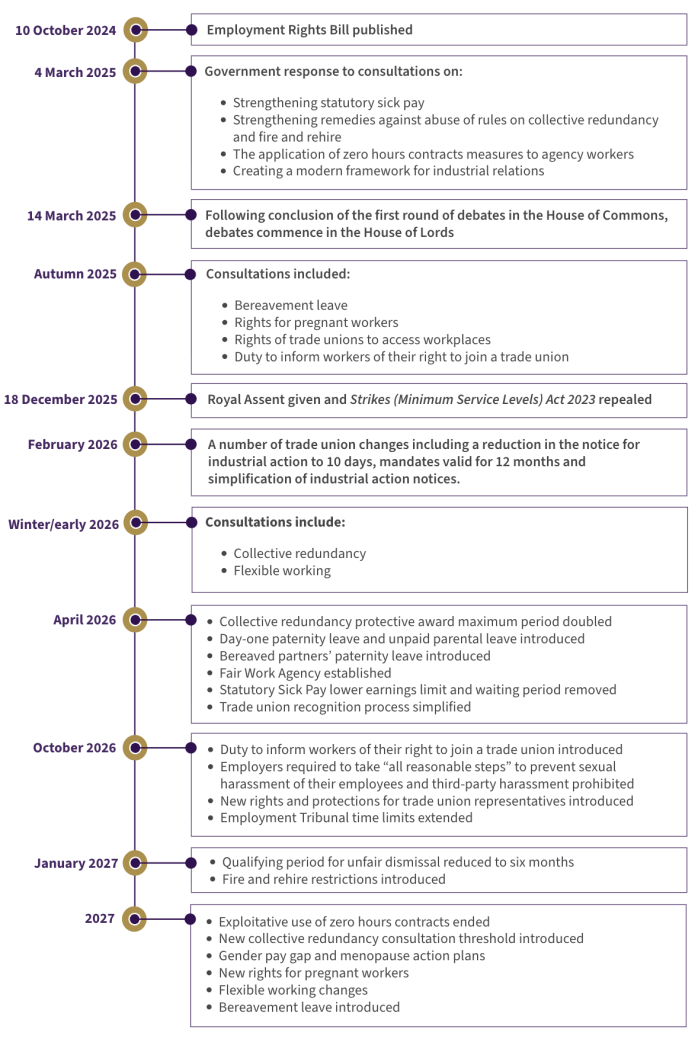
The Employment Rights Bill, published on 10 October 2024, was described as the biggest upgrade to rights at work for a generation. Royal Assent was given on 18 December 2025 and we now refer to the Employment Rights Act 2025. The key measures in the Act will impact most UK employers.
What are the proposals?


BlakeMorgan.co.uk
Exploitative use of zero hours contracts ended
New collective redundancy consultation threshold introduced
Gender pay gap and menopause action plans
New rights for pregnant workers
Flexible working changes
Bereavement leave introduced
Duty to inform workers of their right to join a trade union introduced
Employers required to take “all reasonable steps” to prevent sexual harassment of their employees and third-party harassment prohibited
New rights and protections for trade union representatives introduced
Employment Tribunal time limits extended
Collective redundancy protective award maximum period doubled
Day-one paternity leave and unpaid parental leave introduced
Bereaved partners’ paternity leave introduced
Fair Work Agency established
Statutory Sick Pay lower earnings limit and waiting period removed
Trade union recognition process simplified
Consultations include:
Collective redundancy
Flexible working
A number of trade union changes including a reduction in the notice for industrial action to 10 days, mandates valid for 12 months and simplification of industrial action notices.
Qualifying period for unfair dismissal reduced to six months and compensation cap removed.
Fire and rehire restrictions introduced
Royal Assent given and Strikes (Minimum Service Levels) Act 2023 repealed
Consultations included:
Bereavement leave
Rights for pregnant workers
Rights of trade unions to access workplaces
Duty to inform workers of their right to join a trade union
Following conclusion of the first round of debates in the House of Commons, debates commence in the House of Lords
Government response to consultations on:
Strengthening statutory sick pay
Strengthening remedies against abuse of rules on collective redundancy and fire and rehire
The application of zero hours contracts measures to agency workers
Creating a modern framework for industrial relations


Offices in:
Cardiff
London
Manchester
Oxford
Reading
Southampton
The contents of this publication are for reference purposes only. They do not constitute legal advice and should not be relied upon as such. Specific legal advice about your specific circumstances should always be sought separately before taking any action based on this publication. Authorised and regulated by the Solicitors Regulation Authority of England and Wales SRA number: 613716
07/26 Public


The time limits for Employment Tribunal claims will be extended from three months to six months. Currently, most claims must be brought within three months although some, e.g. statutory redundancy pay, already have a six month time limit.
Employers must inform workers about their right to join a trade union. The Act repeals “minimum service levels”, simplifies industrial action notices, makes balloting more accessible, improves transparency around trade union recognition and gives trade unions access to workplaces for recruitment and organising.
Large employers will be required to produce action plans on how to address their gender pay gaps and how to support employees through the menopause.
Collective consultation is triggered where an employer proposes to dismiss as redundant, within 90 days or less, either 20 or more employees at “one establishment” or at least the “threshold number of employees” (not yet decided). The maximum protective award has been doubled.
Employers’ duty to take reasonable steps to prevent sexual harassment will be extended to taking“all” reasonable steps. Protection from third party harassment will be reinstated to the Equality Act 2010. Sexual harassment disclosures will count as “qualifying disclosures” for whistleblowing purposes.
The lower earnings limit and current waiting period of 3 days before SSP is paid have been removed with SSP paid from day one of sickness absence. Employees will be paid the lower of the flat weekly rate of SSP or 80% of their normal weekly earnings.
Employers will have to state why it was “reasonable” to refuse a flexible working request and there will be a new general day-one right to bereavement leave. There will also be improved protection for pregnant women and those on family leave returning to work. Parental and paternity leave will become a day-one right.
It will be automatically unfair to dismiss an employee where the employer makes a “restricted variation” to the contract (a reduction in pay and time off or a change to working hours) and the employee refuses to agree to that variation unless the reason for it is the employer’s financial circumstances.
Employers must offer a guaranteed hours contract if someone works regular hours over a defined period (they do not have to accept). Employers must give reasonable notice of shifts and pay for shifts cancelled or changed at short notice. The provisions apply to agency workers.
The qualifying period for unfair dismissal will be reduced from the current two years’ continuous employment to six months. The unfair dismissal compensation limits will be removed (52 weeks’ pay cap or the current limit of £123,543).
The Government has confirmed that most changes will take effect between April 2026 and 2027. In addition, there will be various consultation papers issued, Regulations published and Codes of Practice updated and new Codes prepared.
On 1 July 2025, the Government published a roadmap with details of implementation dates from April 2026.
We have created an Employment Rights Act 2025 hub on our website, where you can find analysis of the Act’s measures, key dates, and information about our upcoming events and training.
The Employment Rights Bill, published on 10 October 2024, was described as the biggest upgrade to rights at work for a generation. Royal Assent was given on 18 December 2025 and we now refer to the Employment Rights Act 2025. The key measures in the Act will impact most UK employers.
July 2026
What are the proposals?


The contents of this publication are for reference purposes only. They do not constitute legal advice and should not be relied upon as such. Specific legal advice about your specific circumstances should always be sought separately before taking any action based on this publication. Authorised and regulated by the Solicitors Regulation Authority of England and Wales SRA number: 613716
07/25 Public
Offices in:
Cardiff
London
Manchester
Oxford
Reading
Southampton
We have created an Employment Rights Act 2025 hub on our website, where you can find analysis of the Act’s measures, key dates, and information about our upcoming events and training.
The Government has confirmed that most changes will take effect between April 2026 and 2027. In addition, there will be various consultation papers issued, Regulations published and Codes of Practice updated and new Codes prepared. On 1 July 2025, the Government published a roadmap with details of implementation dates from April 2026.
The time limits for Employment Tribunal claims will be extended from three months to six months. Currently, most claims must be brought within three months although some, e.g. statutory redundancy pay, already have a six month time limit.
Employers must inform workers about their right to join a trade union. The Act repeals “minimum service levels”, simplifies industrial action notices, makes balloting more accessible, improves transparency around trade union recognition and gives trade unions access to workplaces for recruitment and organising.
Large employers will be required to produce action plans on how to address their gender pay gaps and how to support employees through the menopause.
Collective consultation is triggered where an employer proposes to dismiss as redundant, within 90 days or less, either 20 or more employees at “one establishment” or at least the “threshold number of employees” (not yet decided). The maximum protective award will be doubled.
Employers’ duty to take reasonable steps to prevent sexual harassment will be extended to taking “all” reasonable steps. Protection from third party harassment will be reinstated to the Equality Act 2010. Sexual harassment disclosures will count as “qualifying disclosures” for whistleblowing purposes.
The lower earnings limit and current waiting period of 3 days before SSP is paid will be removed with SSP paid from day one of sickness absence. Employees will be paid the lower of the flat weekly rate of SSP or 80% of their normal weekly earnings.
Employers will have to state why it was “reasonable” to refuse a flexible working request and there will be a new general day-one right to bereavement leave. There will also be improved protection for pregnant women and those on family leave returning to work. Parental and paternity leave will become a day-one right.
It will be automatically unfair to dismiss an employee where the employer makes a “restricted variation” to the contract (a reduction in pay and time off or a change to working hours) and the employee refuses to agree to that variation unless the reason for it is the employer’s financial circumstances.
Employers must offer a guaranteed hours contract if someone works regular hours over a defined period (they do not have to accept). Employers must give reasonable notice of shifts and pay for shifts cancelled or changed at short notice. The provisions apply to agency workers.
The qualifying period for unfair dismissal will be reduced from the current two years’ continuous employment to six months. The unfair dismissal compensation limits will be removed (52 weeks’ pay cap or the current limit of £118,223).